
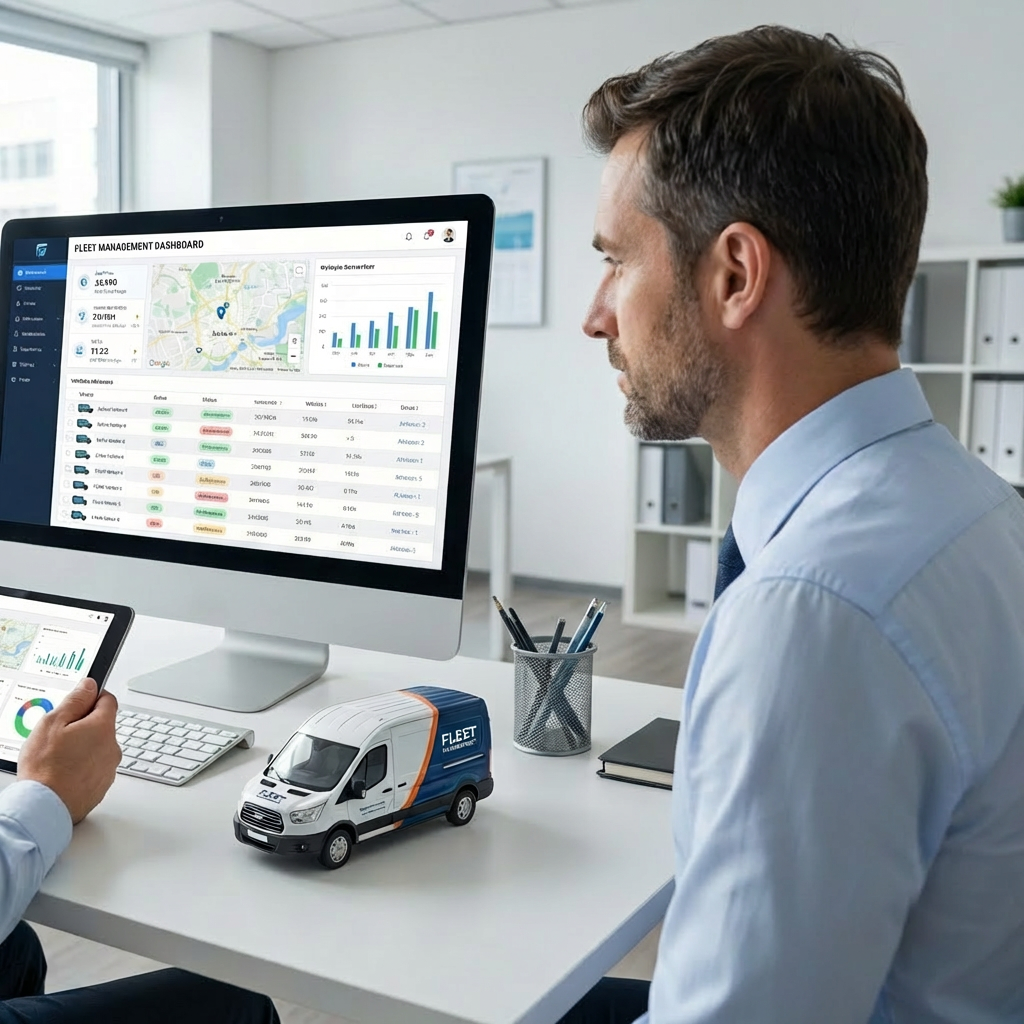
Effective route optimisation fleet strategy reduces fuel costs by 10–20%, but fuel savings are only the beginning. For fleets of 10–50 vehicles, smarter routing cuts unnecessary kilometres, reduces vehicle wear, improves delivery reliability, and gives fleet managers the data they need to make operational decisions based on evidence rather than habit. Here’s how route planning translates into measurable savings across every dimension of fleet operations.
What does route optimisation actually mean for a small fleet?
Route optimisation fleet management isn’t just about finding the shortest path between two points. For commercial fleets, it means planning vehicle movements to minimise total operational cost — balancing distance, time, vehicle capacity, driver hours, delivery windows, and return-to-depot requirements.
For a fleet of 30 vehicles each driving 150 km per day, reducing average daily distance by just 10% saves 450 km per day across the fleet. At a fuel cost of €0.13 per kilometre (diesel van), that’s €58 per day, €1,276 per month, and €15,300 per year — from a single optimisation that changes no other part of the operation.
But the real value extends beyond fuel. Every unnecessary kilometre also means additional tyre wear (€0.02–0.04 per km), accelerated service intervals, increased insurance risk exposure, and wasted driver hours that could be allocated to productive stops.
How much do inefficient routes actually cost?
Most fleet managers underestimate route inefficiency because they’ve never measured it. Drivers tend to follow familiar routes rather than optimal ones — they avoid roads they dislike, default to highways when surface roads are faster for short trips, and sequence stops in the order they received them rather than the order that minimises total distance.
A European Transport Safety Council study found that commercial fleets operating without systematic route planning drive an average of 15–25% more kilometres than necessary. For a fleet spending €200,000 per year on fuel, that’s €30,000–50,000 in avoidable fuel costs — before counting the associated maintenance, tyre, and time costs.
The time cost is equally significant. A driver spending 30 extra minutes per day on inefficient routing loses 11 working hours per month. For a fleet of 20 drivers, that’s 220 lost hours per month — equivalent to 1.3 full-time employees doing nothing productive.
What are the key components of fleet route planning?
Effective route optimisation fleet planning for small and mid-size fleets involves several elements that work together:
Trip logging and mileage tracking. Before you can optimise routes, you need to know what your current routes look like. Logging every trip — start point, end point, distance, purpose — creates the baseline data that reveals inefficiencies. Fleet management platforms like Movcar let drivers log trips directly from their phone, with odometer readings synced to the fleet manager’s dashboard automatically.
Business vs. personal mileage separation. In many EU countries, business mileage is tax-deductible while personal use of company vehicles is taxable income. Accurate trip logging with clear purpose categorisation (business, commute, personal) is essential for tax compliance. Movcar’s routes module captures this distinction per trip, making tax reporting straightforward.
Stop sequence planning. For fleets making multiple deliveries or service calls per day, the order of stops matters enormously. Visiting 8 customers in geographic sequence rather than order-received sequence can reduce daily driving distance by 20–30%. Even without dedicated routing software, simply reviewing tomorrow’s stops on a map and resequencing them saves kilometres immediately.
Return-to-depot planning. Vehicles that need to return to base for loading, refuelling, or driver changeover require routes that account for the return journey. Planning outbound routes without considering the return trip creates unnecessary deadhead kilometres — vehicles driving empty with no productive purpose.
Driver hours compliance. For commercial vehicles subject to driving hours regulations, routes must account for mandatory rest breaks. A route that looks efficient on paper but requires 5 hours of continuous driving is illegal for a regulated driver — and the resulting break may negate the time savings.
How does mileage data improve fleet decisions?
Route and mileage data isn’t just about fuel savings — it feeds into broader fleet management decisions:
Vehicle replacement timing. Vehicles accumulating significantly higher mileage than fleet average are approaching end-of-life faster. Mileage tracking per vehicle helps predict when each vehicle will reach its optimal replacement point — the moment where rising maintenance costs exceed the benefit of continued operation.
Cost-per-kilometre analysis. Combining mileage data with cost data reveals the true operating cost per kilometre per vehicle. A vehicle that appears cheap to maintain but drives twice the fleet average may actually be your most expensive asset per kilometre. Platforms like Movcar’s expense and mileage reports provide this analysis automatically.
Territory rebalancing. If one driver consistently covers 200 km per day while another covers 80 km, the workload distribution is uneven. Mileage data makes these imbalances visible, enabling rebalancing that reduces wear on high-mileage vehicles and distributes costs more evenly.
Insurance negotiations. Accurate annual mileage data per vehicle strengthens your position in insurance renewals. If your fleet’s actual mileage is lower than the insurer’s assumption, you can negotiate lower premiums. Fleet managers who provide verified mileage data report saving 5–10% on fleet insurance renewals.
What tools does a small fleet need for route management?
Enterprise fleets use dedicated route optimisation fleet software with real-time traffic integration, AI-powered stop sequencing, and GPS-based route adherence monitoring. For fleets under 50 vehicles, that level of technology is usually overkill — and expensive at €20–50 per vehicle per month.
What small fleets need is simpler but equally important:
Trip and mileage logging. Every trip recorded with distance, purpose, and route. Drivers log this from their mobile app — it takes under a minute per trip and creates the data foundation for everything else.
Mileage reports. Weekly and monthly mileage summaries per vehicle, exportable to Excel for accounting, tax deduction, and operational review. Movcar’s mileage reports provide exactly this — per vehicle, per driver, per date range, one-click export.
Route history. A searchable record of every trip every vehicle has taken. When a customer asks “when did your driver visit us last?” or an insurer asks for trip documentation, the answer is available in seconds.
Cost-per-km calculation. Combining fuel costs, maintenance costs, and mileage into a per-kilometre cost figure per vehicle. This is the metric that drives replacement, rebalancing, and budgeting decisions.
Movcar covers all four at €0.40 per vehicle per month — trip logging, mileage reports, route records, and cost integration. No GPS hardware required. No dedicated route optimisation fleet subscription. Just the operational data that turns route management from guesswork into measurement.
A practical route optimisation fleet checklist
If you’re not currently tracking routes systematically, start here:
- Enable trip logging for all drivers — use a mobile app that captures start, end, distance, and purpose per trip. Even manual logging is better than no logging.
- Review weekly mileage reports — look for vehicles with unusually high daily distances. Investigate whether the routes are efficient or habitual.
- Separate business and personal mileage — ensure every trip is categorised correctly for tax compliance. This is a legal requirement in most EU countries for company vehicles.
- Compare planned vs. actual routes — if a driver is assigned 5 stops, does the actual mileage match what efficient sequencing would predict? Large discrepancies indicate routing inefficiency.
- Use mileage data in cost reviews — include per-vehicle mileage in your monthly cost analysis. High mileage plus high costs is a vehicle that needs attention.
The bottom line
Route optimisation fleet management for small fleets isn’t about expensive software or GPS tracking — it’s about measuring what your vehicles actually do and using that data to make better decisions. A fleet that logs every trip, reviews mileage reports, and tracks costs per kilometre will naturally find and eliminate inefficiencies.
The fuel savings alone — 10–20% reduction from systematic route optimisation fleet management — justify the effort. But the secondary benefits — extended vehicle life, reduced tyre costs, better insurance rates, tax-compliant mileage records, and data-driven replacement planning — multiply the return many times over.
For fleet managers ready to systemise route planning alongside maintenance and document tracking, see our guide to the best fleet management software for small business — it covers tools that combine route optimisation with broader fleet operations.
Ready to simplify fleet management?
Movcar scales from 3 to 5,000+ vehicles at the lowest per-vehicle price in the space. Paid plans from €0.40/vehicle/month. 26+ languages, EU-hosted, GDPR-compliant. 14-day free trial on any paid plan.
Frequently asked questions
How much can fleet route optimisation actually save? Typical fleets cut fuel by 10-20%, overtime by 5-15% and improve customer-promised arrival accuracy by 25-40%. Savings scale with fleet size and route complexity.
Do I need GPS tracking for fleet route optimisation? No. Static route optimisation using known addresses, time windows and vehicle capacities works without GPS. GPS adds live re-routing, which matters most for fleets with frequent same-day changes.
What is the difference between route planning and route optimisation? Planning assigns stops to vehicles and orders them. Optimisation tries multiple sequence permutations to minimise total distance, time or cost subject to constraints like time windows.
Is route optimisation worth it for fleets under 20 vehicles? Yes. Even at 5-10 vehicles, optimisation typically pays back its software cost within 2-3 months through fuel and overtime savings.